
Project outputs and dissemination
Peer-reviewed publications
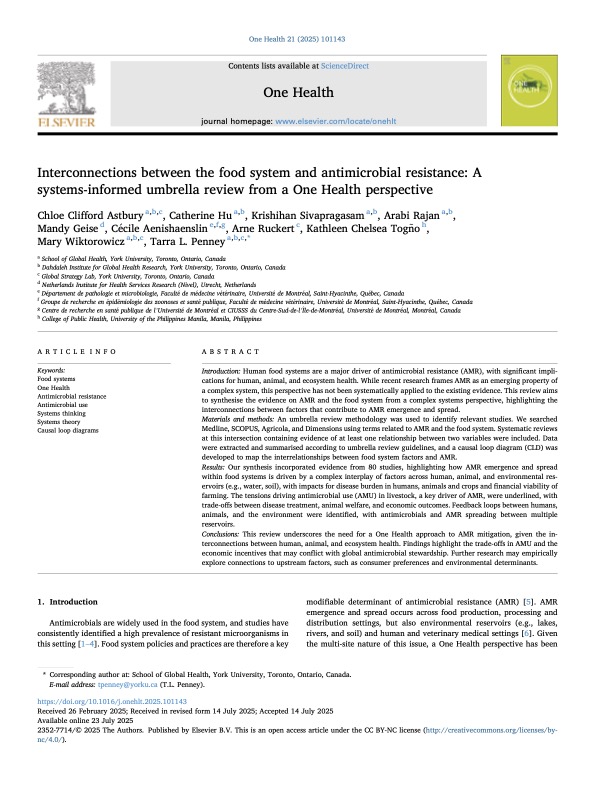
Supporting One Health policies to manage antibiotic resistance in Senegal: a systems analysis using group model building
Frontiers in Public Health, 2025
Antibiotic resistance (ABR) in Senegal is shaped by tightly linked human, animal, and environmental factors. This study uses a participatory systems approach to map how these drivers interact and identify where policy action could make the most meaningful impact.
A multi-sectoral workshop with 22 stakeholders generated causal loop diagrams capturing 55 factors and 88 connections influencing the emergence and spread of ABR in Senegal. Four major feedback loops were identified around antibiotic demand, public perceptions and misinformation, the development of context-appropriate regulations, and the enforcement of those regulations. Participants proposed 36 potential interventions, with the most transformative including strengthening laboratory capacity, enforcing rules against illegal medication sales, and harmonising data collection across surveillance systems.
The study demonstrates the value of systems thinking for understanding ABR as a complex, interconnected challenge. While the findings reflect national-level perspectives, they offer practical insights for One Health governance and underscore the need to involve local actors to ensure policies are feasible, context-appropriate, and effective.
Read the paper here.
Lead and corresponding author: Mouhamadou Moustapha Sow

Interconnections between the food system and antimicrobial resistance: A systems-informed umbrella review from a One Health perspective
One Health, 2025
Human food systems are a major driver of antimicrobial resistance (AMR), with significant implications for human, animal, and ecosystem health. While recent research frames AMR as an emerging property of a complex system, this perspective has not been systematically applied to the existing evidence. This review aims to synthesise the evidence on AMR and the food system from a complex systems perspective, highlighting the interconnections between factors that contribute to AMR emergence and spread.
This review underscores the need for a One Health approach to AMR mitigation, given the interconnections between human, animal, and ecosystem health. Findings highlight the trade-offs in AMU and the economic incentives that may conflict with global antimicrobial stewardship. Further research may empirically explore connections to upstream factors, such as consumer preferences and environmental determinants.
Read the paper here.
Lead author: Chloe Clifford Astbury – Corresponding author: Tarra Penney
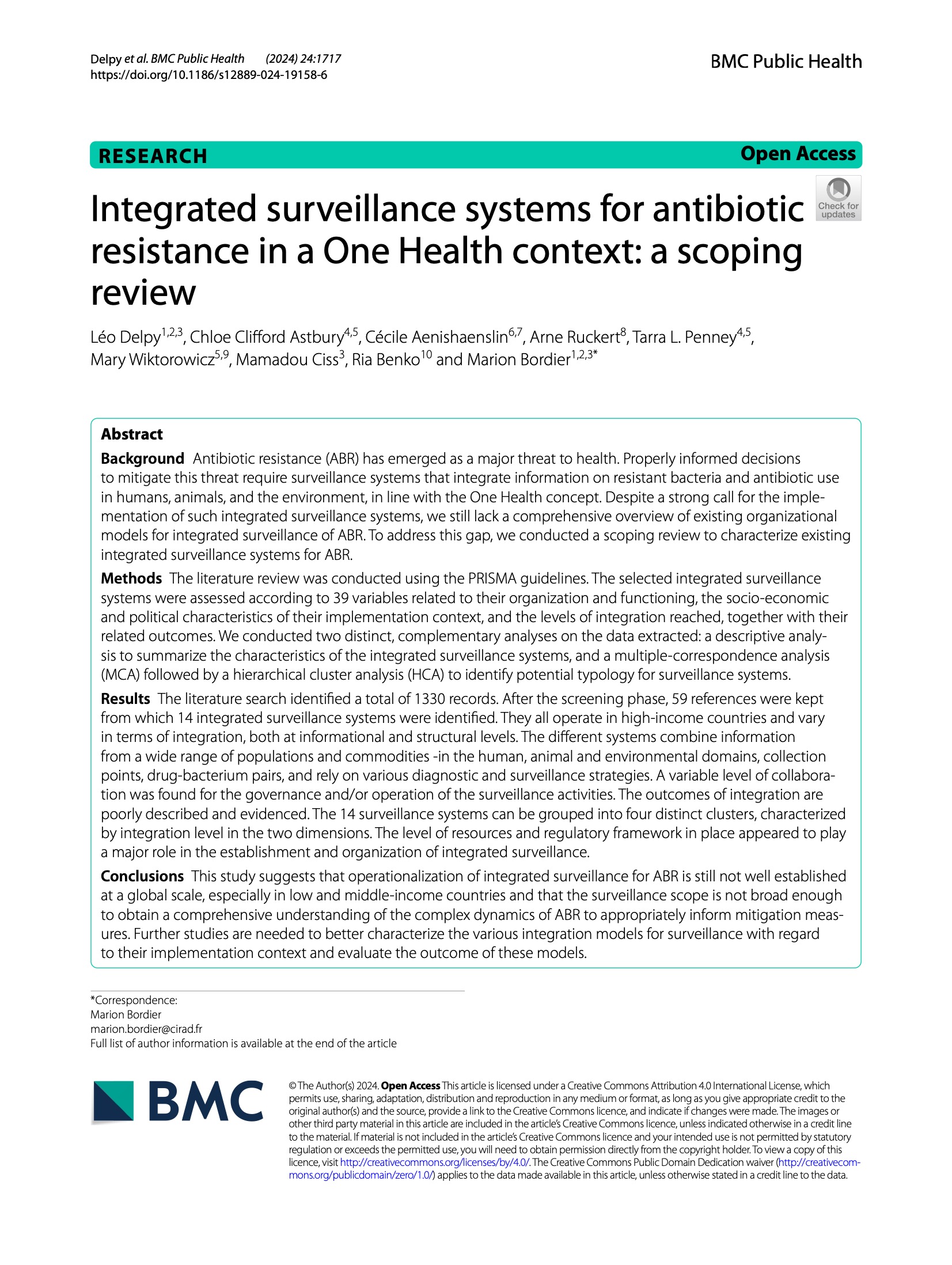
Integrated surveillance systems for antibiotic resistance in a One Health context: a scoping review
BMC Public Health, 2024
Antibiotic resistance (ABR) has emerged as a major threat to health. Properly informed decisions to mitigate this threat require surveillance systems that integrate information on resistant bacteria and antibiotic use in humans, animals, and the environment, in line with the One Health concept. Despite a strong call for the implementation of such integrated surveillance systems, we still lack a comprehensive overview of existing organizational models for integrated surveillance of ABR. To address this gap, we conducted a scoping review to characterize existing integrated surveillance systems for ABR.
This study suggests that operationalization of integrated surveillance for ABR is still not well established at a global scale, especially in low and middle-income countries and that the surveillance scope is not broad enough to obtain a comprehensive understanding of the complex dynamics of ABR to appropriately inform mitigation measures. Further studies are needed to better characterize the various integration models for surveillance with regard to their implementation context and evaluate the outcome of these models.
Read the paper here.
Lead author: Léo Delpy – Corresponding author: Marion Bordier
Presentations
Mind the gap: a deep dive into official papers of Hungarian antibiotic policy
Poster presentation at 4th International Conference Antimicrobial Resistance – current state and perspectives, 2025
Presenter: Andrea Szabó
Barriers and possibilities: One Health concept in the Hungarian antimicrobial stewardship
Oral presentation at 2nd Debrecen Online Conference on Infectious Diseases in a One Health context (DOCIDOH), 2025
Presenter: Andrea Szabó

Appearance of the One Health approach in the Hungarian antimicrobial stewardship – results of a document analysis
Oral presentation at JOINT EUFEPS – ÖPhG MEETING, 2025
Presenter: Andrea Szabó

DESIGN project: Designing One Health governance for AMR
Oral presentation at JPIAMR Conference, 2025
Presenter: Foekje Stelma

Analysis of the determinants contributing to antibiotic resistance in Senegal using systems analysis from a One Health perspective
Oral presentation at AFROHUN Conference, 2024
Presenter: Mouhamadou Moustapha Sow
Analysis of One Health governance of antimicrobial resistance in Senegal: obstacles and levers for improvement
Poster presentation at World One Health Congress, 2024
Presenter: Mouhamadou Moustapha Sow

Policy network and advocacy coalition framework: A case study of national policy to combat antimicrobial resistance with One Health in Senegal
Poster presentation at World Congress of Epidemiology, 2024
Presenter: Mouhamadou Moustapha Sow

How does the food system influence antimicrobial resistance? A complex systems analysis in five countries
Poster presentation at Geneva Health Forum, 2024
The food system is a key contributor to the emergence and spread of antimicrobial resistance (AMR), with negative repercussions for human, animal and environmental health. While numerous pathways linking the food system to AMR have been identified, the relationships between these factors are complex. Recent research situates AMR as an emerging property of a complex system, but efforts to characterise this system across different countries are limited. Given the multi-sectoral nature of AMR, a One Health perspective has been advocated to understand and control the emergence and transmission of resistance. We use a participatory approach to identify key food system factors that influence AMR, as well as the interconnections and dynamic relationships between them. We undertake this analysis in five countries (Canada, Hungary, the Netherlands, the Philippines and Senegal), spanning high-, middle- and low-income contexts, as well as different governance systems and policy environments.
Presenter: Chloe Clifford Astbury

Applying a One Health approach to the governance of AMR: A JPIAMR-funded project (DESIGN)
Canadian Institutes of Health Research One Health AMR Symposium, 2023
Presenter: Mary Wiktorowicz
Designing One Health Governance for Antimicrobial Stewardship
JPIAMR start-up workshop for HARISSA projects, 2022
Presenter: Mary Wiktorowicz
Workshop reports

Designing AMR Governance: Senegal Systems Workshop Summary Report
October 2023
Antibiotic resistance (ABR) in Senegal is shaped by interconnected human, animal, and environmental factors. As part of the six-country Designing AMR Solutions project, a national systems workshop was held in October 2023 to better understand these drivers and identify priority actions for antibiotic stewardship.
Thirty contributors from human, animal, and environmental health sectors worked together over three days to map the factors influencing ABR, explore cross-sectoral perspectives, and identify points for effective intervention. Participants agreed that ABR is likely to worsen without targeted action, highlighting persistent challenges in surveillance, infrastructure, training, and regulatory enforcement. Their discussions underscored the need for stronger coordination across sectors and governance levels, as well as investment in capacity, particularly in veterinary services and border control contexts.
The workshop concluded with a set of priority actions and recognition of barriers to implementation, including resource limits and workforce gaps. Next steps include a follow-up workshop with local-level actors and the integration of insights across all participating countries to support the development of context-appropriate AMR policy and governance.
Read the report here.

Designing AMR Governance: Canada Systems Workshop Summary Report
February 2024
Antimicrobial resistance (AMR) in Canada is influenced by complex interactions across human, animal, and environmental sectors. In February 2024, a national systems workshop brought together ten stakeholders to map these factors, share cross-sectoral perspectives, and identify priority actions for AMR stewardship as part of the six-country Designing AMR Solutions project.
Participants highlighted that AMR is likely to continue increasing under current conditions, with trends varying by sector and strain. Discussions underscored the importance of cross-sectoral collaboration, economic drivers in food production, and global influences such as climate change, conflict, and misinformation. Contributors identified priority actions to strengthen governance, reduce antimicrobial use, and improve coordination, while noting implementation challenges including political will, public investment, and evidence gaps.
This workshop is one of several planned globally. Insights from all workshops will be integrated to inform context-appropriate policies and governance for antimicrobial stewardship and shared with participants to support national and international action.
Read the report here.

Designing AMR Governance: Hungary Systems Workshop Summary Report
April 2024
Antimicrobial resistance (AMR) in Hungary is shaped by interconnected human, animal, and environmental factors. In April 2024, a national systems workshop brought together seven stakeholders to map these factors, share cross-sectoral perspectives, and identify priority actions for AMR stewardship as part of the six-country Designing AMR Solutions project.
Participants highlighted that AMR is likely to increase if current conditions persist, identifying a range of contributing factors across sectors. Discussions emphasized the importance of cross-sectoral collaboration, challenges with surveillance and data quality, and context-specific issues such as regulatory and media influences, agricultural practices, and changing population health beliefs. Contributors proposed priority actions to strengthen governance and coordination, while noting that progress depends on political will and public investment.
Read the report here.

Designing AMR Governance: Netherlands Systems Workshop Summary Report
June 2024
Antimicrobial resistance (AMR) in the Netherlands is shaped by complex interactions across human, animal, and environmental sectors. In June 2024, a national systems workshop brought together seven stakeholders—including researchers and policymakers—to map these factors, share cross-sectoral perspectives, and identify priority actions for AMR stewardship as part of the six-country DESIGN project.
Participants discussed how AMR trends vary across sectors, organisms, and production systems, noting substantial progress in reducing antimicrobial use but continued risks from cross-sectoral and international influences. Key factors identified included antimicrobial use practices, policy frameworks, and economic considerations in food production. Contributors emphasized the importance of cross-sectoral collaboration, stewardship, surveillance, and prevention, while recognizing the potential influence of regional and global dynamics. Priority actions were identified across short-, medium-, and long-term timeframes to strengthen governance, coordination, and capacity for AMR mitigation.
Read the report here.
Media coverage

Governance of antimicrobial stewardship based on the One Health approach on the agenda of a workshop in Senegal
VivAfrik, 2022
Read more here (article in French).

Governance of antimicrobial stewardship based on the One Health approach in Senegal: ISRA and its partners launch the project in Dakar
ISRA, 2022
Read more here (article in French).